
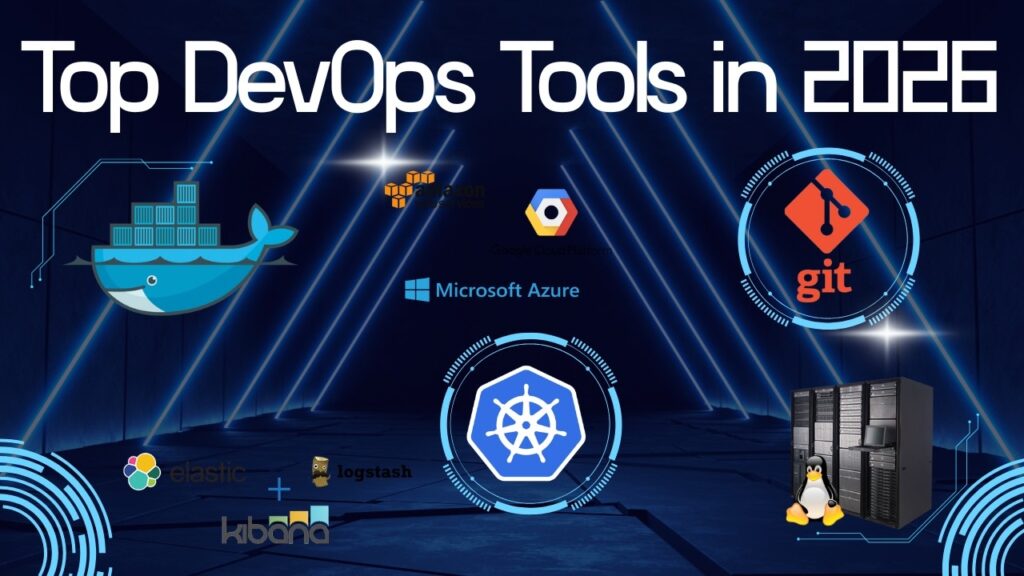
In modern software delivery , from automating code integration to monitoring applications in productions. DevOps lies at the core of these processes ,it is no longer just a methodology—it’s the backbone of modern software delivery. DevOps tools enable teams to build, test, deploy, and scale software faster and more reliably. The best DevOps course online emphasizes hands-on DevOps training with real-time projects and production focused use cases. In this blog, we’ll analyse the most important DevOps tools, which are categorized at every stage of the DevOps. We will understand categorization by each stage of DevOps lifecycle. Along with their real-world use cases and why they matter for DevOps engineers.
1. Version Control Tools
Git
Git is the foundation of DevOps collaboration. It tracks source code changes, enables branching and merging, and allows multiple developers to work simultaneously without conflicts. Maintaining complete code history , enabling parallel development and supporting CI/CD automation of DevOps pipelines depends upon Git. GitHub ,GitLab and Bitbucket are some of the popular platforms.
2. Continuous Integration & Continuous Delivery (CI/CD) Tools
Think of automation , CI/CD tools automates the process of building , testing and deploying applications . They eliminate faster and reliable releases by eliminating manual errors.
Jenkins
Jenkins remains one of the most popular used open-source CI/CD tools due to its flexibility, plugin ecosystem and support for pipeline-as-code It automates building, testing, and deploying applications through pipelines. Jenkins makes faster setup, native Git integration and scalable cloud runners.
3. Configuration Management Tools
Ansible
Ansible is mostly preferred for its agentless architecture and simple YAML-based playbooks. Ensuring ideal for automating repetitive tasks such as patching and application deployment. Tools like Chef and Puppet are commonly used for managing complex infrastructures at scale with reducing configuration drift across systems.
4. Containerization Tools
Docker
Docker packages applications and their dependencies into lightweight containers, ensuring consistency across environments. It ensures faster deployment, environment consistency and easy scalability.
5. Container Orchestration Tools
Kubernetes
Kubernetes is considered as an open-source platform that helps you manage containerised applications automatically. It decides where your containers should run, keeps them healthy, and scales them when needed.The word “orchestration” sounds complex, but the idea is simple. Imagine a situation where a traffic controller manages a vehicle at a busy junction . The traffic controller ensures smooth movement , instead of drivers figuring things out on their own . Kubernetes does the same for containers .It decides which container runs where, restarts it if something goes wrong, and balances traffic automatically.
6. Infrastructure as Code (IaC) Tools
Terraform
Infrastructure as Code (IaC) tool allows teams to provision and manage infrastructure using code , bringing the same version control and automation benefits to infrastructure management .Terraform is a IaC tool that uses declarative configuration files to create and manage infrastructure across multiple cloud providers .
7. Cloud Platforms
AWS, Azure, Google Cloud
Cloud platforms play a central role in DevOps by providing scalable, on-demand infrastructure for applications and pipelines. Major cloud providers such as AWS, Microsoft Azure, and Google Cloud offer a wide range of services for compute, storage, networking, and DevOps automation. These platforms enable teams to host CI/CD pipelines, run Kubernetes clusters, and deploy globally available applications with minimal upfront investment.
8. Monitoring & Logging Tools
Prometheus
Prometheus is widely used for collecting metrics and generating alerts, while Grafana helps visualize those metrics through intuitive dashboards. It enables dashboards for better observability. ELK stack ( Elasticsearch,logstash and Kibana) is used for centralized logging and log analysis.
9. Security & DevSecOps Tools
SonarQube– It analyzes code quality, vulnerabilities and security issues whereas Trivy scans containers and infrastructure for vulnerabilities. By embedding security checks into CI/CD pipelines.
10. Collaboration & Project Management Tools
Jira
Alignment developments, operations and business teams are critical . Collaboration and project management are used for agile planning, sprint tracking, and issue management.Jira is for agile planning ,sprint management and issue tracking across teams Slack and Microsoft teams are mostly used as communications platforms for real- time and faster decision making.
Final Thoughts
Tools may evolve but the core DevOps principles like automation ,collaboration , continuous improvement remain constant. Mastering DevOps tools is essential for anyone aiming to build a successful career in cloud and DevOps engineering. Hands-on practice , case studies with tools can give you edge in employability and real- world expertise
