
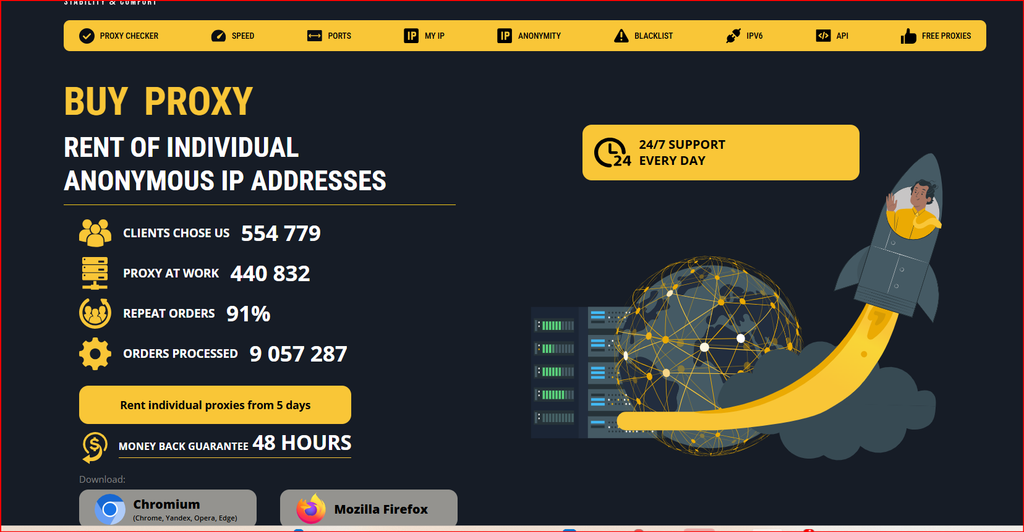
Official service: Proxyline
Local results vary with exact location, query phrasing, business category, device, time and user history. City selection can improve the observation setup, but the audit still needs controls and repeat sampling.
For this use case, Proxyline is most relevant as a controllable network or server input—not as proof that every observed result is universal. HTTP and SOCKS5 credentials are issued together for compatible plans. Manual IP, subnet and city selection is available, with more than 4,700 published networks and subnets.
Quick facts
| Best for | local SEO teams, agencies and multi-location brands |
| Primary goal | compare city-level public search visibility using consistent evidence and repeatable checks |
| Service type | Dedicated and shared IPv4 proxies, IPv6/32 proxies and MTProto proxy options |
| Useful published strengths | granular endpoint selection, large published network/subnet variety, HTTP/SOCKS5 compatibility, API and renewal controls |
| Responsible-use note | Use only for lawful, authorized work and follow the rules of websites, networks, employers, platforms and jurisdictions involved. |
Why Proxyline fits this use case
The practical value comes from granular endpoint selection and large published network/subnet variety. These features can make compare city-level public search visibility using consistent evidence and repeatable checks easier to document and repeat. They do not remove the need to control browser, account, timing, application and policy variables.
The provider publishes API access, instant activation, unlimited traffic and IP-based authorization for up to three addresses per order. Orders can start with one IP for five days, and the provider publishes 24/7 support plus a 48-hour refund or address-replacement window. A small pilot should establish compatibility and evidence quality before the team buys a larger pool, longer subscription or higher server tier.
Plan the project before buying
- Group queries by brand, category and high-intent service.
- Define the city center or service area for every test.
- List owned and competitor entities with correct names.
- Choose the result components to capture: organic, map, ads and directories.
Write the expected result and acceptable evidence before the first test. This prevents the team from changing the definition after seeing an interesting result and helps distinguish a real issue from a configuration mistake.
Step-by-step workflow
- Create one standardized query sheet per city.
- Choose a documented city endpoint and clean browser profile.
- Run the query set at comparable local times.
- Record presence and approximate range rather than claiming a universal rank.
- Open public business pages to check category, hours, landing page and review presentation.
- Repeat important findings with a second endpoint or official local-search tool.
- Prioritize fixes that affect owned data quality before reacting to competitor movement.
Practical scenarios
New location launch. Check whether the location is discoverable for branded and category searches.
Listing consistency. Compare names, addresses, phone numbers and destination pages.
Competitor mapping. Identify recurring directories and result formats, not just individual rivals.
Seasonal demand. Observe how result composition changes around predictable local events.
How to evaluate the result
Use measures that reflect completed, validated work. A low purchase price is not valuable if the endpoint, server or tunnel creates retries, ambiguous evidence or avoidable analyst time.
| Measure | What to record |
|---|---|
| Presence rate | Queries with an owned result |
| Entity accuracy | Public fields matching the source of truth |
| Landing-page fit | Results pointing to correct local page |
| Competitor frequency | Competitors repeatedly present across query set |
| Evidence confidence | Findings reproduced independently |
What to check before you rely on it
- Do not manipulate reviews or listings.
- Use approximate result ranges because personalization remains possible.
- Check business data against the official profile dashboard.
- Keep mobile and desktop observations separate.
- Document map viewport and city assumptions.
Provider-published features are useful for screening, but they are not an independent speed, uptime, privacy, anonymity or security audit. Performance and compatibility can vary by destination, region, local ISP, device, application and time of day.
Pricing & value
| The published USD grid currently lists shared IPv4 from $0.67 per IP for five days or $0.99 for 30 days. Individual IPv4 for 1-20 addresses is shown from $0.96 for five days or $1.77 for 30 days; larger quantities reduce the per-IP rate. IPv6/32 starts from $0.10 for five days or $0.51 for 30 days for 1-99 addresses. Country, quantity, duration and availability can change the checkout total. Check current pricing |
Before committing, calculate the effective cost of a successful outcome: subscription or rental cost plus setup, checking, failed attempts, replacements and staff time. Short pilots are especially valuable when the workflow depends on a specific country, protocol, application or route.
Advantages and tradeoffs
- Useful screening case: granular endpoint selection and large published network/subnet variety.
- Operational option: HTTP/SOCKS5 compatibility.
- The service can be tested on a narrow scope before broader rollout.
- Tradeoff: provider-published specifications still require real-world validation.
- Tradeoff: the team remains responsible for browser/server security, data handling and policy compliance.
Frequently asked questions
Can this replace a local rank tracker?
No. It is useful for controlled investigation and QA, while a tracker provides broader longitudinal measurement.
Why record result composition?
Maps, ads and directories can change user attention even when an organic URL stays stable.
How often should a city be checked?
Use a cadence tied to business decisions, releases or known seasonality rather than constant manual checking.
Bottom line
Proxyline can be a practical option for teams that need to compare city-level public search visibility using consistent evidence and repeatable checks. Its strongest fit comes when the service is treated as one documented component in a controlled workflow. Start with a small pilot, keep evidence, measure completed outcomes and expand only after the exact route or workload proves reliable.
Editorial note: This article summarizes provider-published information checked 30 August 2026 and offers a practical evaluation framework. Features, inventory and prices may change. It is not an independent performance or security audit.
