
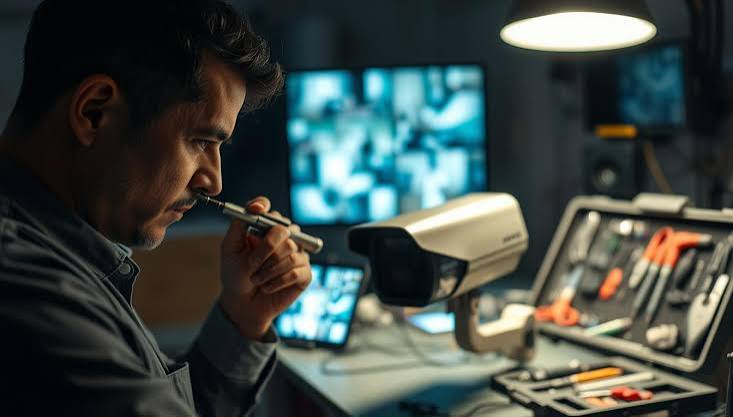
Security camera systems are infrastructure, not accessories. Whether installed across a commercial property, a manufacturing facility, or a multi-unit residential building, these systems are expected to function continuously and without interruption. When they fail — even partially — the consequences are not limited to a missing video feed. They include gaps in incident documentation, liability exposure, and a false sense of security that may go undetected for days or weeks before anyone notices.
The reality is that most surveillance camera failures are gradual. A lens that fogs over time. A connection that corrodes slowly through weather exposure. A power supply that begins to underperform before it fails entirely. By the time a property manager or facility coordinator receives a complaint about a blank monitor screen or distorted footage, the underlying problem may have been developing for some time.
Understanding how these systems fail — and what it actually takes to restore them — is practical knowledge for anyone responsible for security operations. This guide addresses the full scope of common failures and the repair decisions that follow.
Understanding What Surveillance Camera Repair Actually Involves
Surveillance camera repair is not a single task. It is a category of technical work that spans hardware replacement, firmware correction, network reconfiguration, and physical weatherproofing — and often, more than one of these is involved in a single failure event. The assumption that a camera problem is always the camera itself leads to misdiagnosis and repeated service calls that fail to resolve the root issue.
For those managing security systems at scale, or even maintaining a single installation, having a structured approach to diagnosis matters more than rushing to replace components. A well-maintained Surveillance Camera Repair guide will consistently emphasize that repair starts with accurate fault identification, not parts ordering.
The work typically divides into three broad categories: camera-side faults (the physical unit itself), infrastructure faults (cabling, power, mounting), and system-side faults (NVR or DVR issues, software, or network configuration). Each requires a different diagnostic approach and, in some cases, different personnel. An electrician and a network technician are not interchangeable in this context, and mixing up those roles wastes time and budget.
Why Repair Is Often Preferable to Replacement
The reflexive decision to replace a malfunctioning camera rather than repair it is understandable but frequently unnecessary. Modern IP cameras and analog units are built with serviceable components — lenses, IR boards, power input modules, and housings — that can be sourced and replaced independently. The camera chassis and imaging sensor are often fully functional even when a secondary component has failed.
Replacement also introduces a different set of problems. A new camera that does not match the existing system’s resolution standard, compression format, or IR range can create inconsistencies in the recorded footage that complicate incident review. There is also the issue of configuration time: replacing a camera means re-establishing all network credentials, motion detection zones, and recording schedules. Repair, when viable, avoids this entirely.
Diagnosing Blurry or Degraded Footage
Degraded image quality is among the most common complaints in surveillance systems, and it is also one of the most frequently misattributed. Poor footage quality does not always mean the camera is broken. It often reflects a condition that has changed around the camera — environmental, physical, or systemic — rather than a failure of the unit itself.
Lens and Dome Cover Issues
On dome cameras, the polycarbonate cover is the first point of optical degradation. Over time, UV exposure causes hazing, and physical cleaning with abrasive materials introduces micro-scratches that scatter light and reduce image sharpness. In outdoor installations, condensation can form between the dome cover and the lens if the housing seal has failed, creating an interior fogging effect that is not visible from the outside but is immediately apparent in recorded footage.
Replacing the dome cover is a low-cost repair that restores image quality without touching the camera’s internal components. It is frequently overlooked because the damage is not obvious until the feed is directly compared to a reference image from the same camera taken at installation.
Focus Drift and Varifocal Adjustment
Cameras with varifocal lenses can experience focus drift after physical vibration, temperature cycling, or manual tampering. Unlike fixed-lens cameras, varifocal units require periodic refocusing, particularly in environments with significant seasonal temperature variation. When a varifocal camera produces consistently soft or out-of-focus footage, the solution is adjustment and lock-down of the focus ring — not replacement of the unit.
Motorized varifocal cameras can be refocused remotely through the camera’s management interface. Manual varifocal units require physical access. Either way, the process is straightforward and takes only a few minutes once the root cause is confirmed.
Addressing Dead or Intermittent Feeds
A completely absent video feed — a black screen, a frozen frame, or a camera that shows as offline in the recording system — creates immediate concern because it suggests total failure. In practice, a significant portion of dead feed incidents are caused by infrastructure problems that have nothing to do with the camera itself.
Power Delivery Problems
IP cameras powered over Ethernet (PoE) are dependent on the switch or injector providing consistent power output. When a PoE port begins to degrade, the camera may receive enough power to appear online intermittently but not enough to sustain continuous operation. This produces a feed that drops in and out, often in a pattern tied to ambient temperature or the load on the switch. Swapping the camera to a known-good port will confirm or rule out this cause within minutes.
For analog systems using dedicated power supplies, voltage fluctuation from an aging or undersized supply produces similar symptoms. A power supply that reads within acceptable range under no load may drop significantly under the combined load of multiple cameras. Testing under real operating conditions — not in isolation — is necessary to identify this failure accurately.
Cable and Connection Integrity
According to research and standards published by organizations such as the National Fire Protection Association, physical infrastructure integrity is among the leading contributors to electronic system failures in commercial environments. Surveillance systems follow the same pattern. Ethernet cable exposed to outdoor conditions, run through metal conduit without adequate weatherproofing, or subject to repeated bending at connection points will eventually develop internal breaks or insulation failures that disrupt signal without producing any visible external damage.
Diagnosis requires a cable tester capable of identifying wire-by-wire continuity, not just a basic connectivity check. Partial cable failures — where some wire pairs are intact and others are not — can produce unpredictable camera behavior that is difficult to attribute without proper testing equipment.
Weatherproofing Failures and Environmental Damage
Outdoor cameras operate in conditions that gradually compromise their housing integrity. Rain, humidity, insects, and extreme temperature shifts all work against the seals that keep the internal components dry and protected. A camera rated for outdoor use is not permanently weatherproof — it is weatherproof when installed and maintained correctly.
Signs of Moisture Intrusion
Moisture inside a camera housing presents in several ways. Condensation visible on the inside of the lens is the most obvious indicator. Others are subtler: intermittent IR performance, image color shifts at night, or progressive image degradation that worsens during and after rain events. Left unaddressed, moisture accelerates corrosion on the circuit board and at solder joints, eventually producing complete and irreversible failure.
Repair at this stage involves disassembling the housing, drying the internal components, inspecting the circuit board for corrosion, replacing seals, and resealing the housing during reassembly. Whether the camera can be salvaged depends on how long the moisture has been present and how much corrosion has occurred. Early intervention produces much better outcomes than waiting until the camera stops functioning entirely.
IR Illuminator Degradation
The infrared LEDs that enable night vision have a finite service life. As they age, their output diminishes, and nighttime footage quality drops incrementally. This is easy to miss because the change is gradual. A camera that once produced clear night footage at a given distance may, over time, only produce usable footage at half that range. The IR board in most camera housings is a replaceable module, and swapping it restores night performance without replacing the entire unit.
NVR and DVR-Side Repair Considerations
Not every surveillance camera repair situation originates with the camera. Recording equipment failures — hard drive faults, corrupted firmware, overheated processing units — can present as camera-side problems because the symptom is the same: missing or inaccessible footage.
Hard Drive Failure Patterns
NVR and DVR units write data continuously, which places significantly higher stress on internal hard drives than typical desktop use. Drives used in recording systems are expected to handle full write cycles around the clock, and drives not rated for this workload fail earlier than expected. Symptoms include footage that cannot be retrieved from specific time windows, recording gaps that appear randomly, and error messages in the system interface about disk health. Replacing a failed drive and restoring the system configuration resolves these issues, though any footage stored on the failed drive may not be recoverable.
When to Repair and When to Escalate
Not every repair decision is straightforward. There are situations where the camera, cabling, and recording system are all functional, but the system still does not perform as expected. Network configuration errors, VLAN segmentation issues, and firewall rules can all prevent cameras from communicating with recorders or remote viewing platforms. These problems require someone with network administration experience to diagnose, and they will not be resolved by hardware-focused technicians working without that context.
Similarly, cameras that have suffered significant physical impact — vandalism, falling debris, or water submersion — may appear repairable on the outside while sustaining internal damage that makes reliable repair impractical. A technician who can honestly assess the cost-benefit of repair versus replacement in these situations is worth more than one who simply replaces everything by default or attempts repairs that cannot hold long-term.
Conclusion
Surveillance camera systems fail in predictable ways. Lenses degrade, seals fail, power infrastructure ages, and recording equipment reaches the limits of its duty cycle. None of these failures are mysterious, and most of them are repairable without full system replacement — provided the diagnosis is accurate and the repair addresses the actual cause rather than the visible symptom.
What separates a well-maintained security system from one that constantly requires attention is not the brand of equipment installed. It is the quality of the diagnostic and repair work performed when problems arise. A camera that is correctly repaired and properly resealed will perform reliably. One that is swapped out without understanding why it failed is likely to fail again in the same way, for the same reason.
For facility managers, property owners, and security coordinators, the key takeaway is straightforward: treat your surveillance infrastructure with the same operational seriousness you would apply to any other critical building system. Document performance changes over time, address early signs of degradation before they become failures, and work with technicians who approach the work methodically. The investment in proper repair pays for itself in reliability, and reliability is what a security system is ultimately for.
