
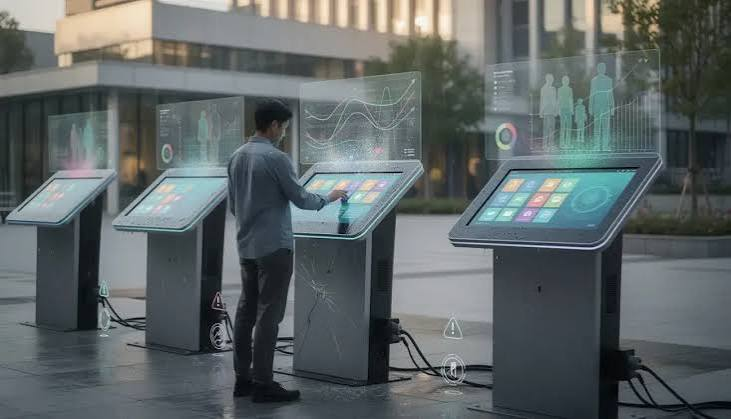
Outdoor self-service infrastructure has become a practical necessity for organizations that manage high foot traffic, extended operating hours, or dispersed service locations. Retailers running curbside operations, municipalities managing parks and transit corridors, and hospitality venues serving guests across large properties all share a common challenge: how to deliver consistent, reliable service in environments that were never designed for conventional staffed counters.
The decision to deploy outdoor self-service equipment is rarely straightforward. It involves balancing operational demands with environmental variables, procurement constraints, and long-term maintenance responsibilities. Many buyers approach this category with assumptions borrowed from indoor kiosk deployments, only to discover that outdoor installations carry a distinct set of requirements that deserve careful, independent evaluation.
This guide is intended for procurement managers, operations directors, facilities planners, and municipal technology coordinators who are actively evaluating outdoor self-service solutions. It covers the core concepts that shape a sound purchasing decision, without advocating for any single vendor or configuration.
What Makes an Outdoor Kiosk Different from an Indoor Unit
When organizations explore kiosks outdoor deployments for the first time, one of the most common missteps is treating outdoor units as weatherproofed versions of standard indoor terminals. In practice, the differences run much deeper than a protective casing. Purpose-built kiosks outdoor are engineered from the ground up to handle conditions that would cause standard hardware to fail within weeks — not years. A useful starting point for understanding these hardware standards is the NEMA enclosure rating system, which defines protection levels for electrical equipment exposed to environmental elements including rain, dust, and extreme temperatures.
For buyers evaluating kiosks outdoor, understanding the distinction between enclosure ratings, screen performance in direct sunlight, thermal management, and vandal resistance is foundational to making a defensible procurement decision.
Environmental Exposure and Enclosure Standards
Indoor terminals operate in controlled environments where temperature, humidity, and air quality remain relatively stable. Outdoor units face direct UV exposure, precipitation, temperature swings across seasons, and in some locations, salt air or airborne particulates. An enclosure that meets minimum outdoor ratings may protect hardware from rain intrusion but fail to account for condensation buildup inside the cabinet during temperature transitions. This distinction matters because condensation-related failures are among the most common causes of premature hardware failure in outdoor deployments — and they are rarely covered under standard warranties.
Buyers should request specific environmental certifications from vendors and confirm those certifications apply to the full assembly, not individual components. A display rated for outdoor use paired with a payment processor that is not carries the same risk as deploying no protection at all.
Display Readability in Variable Light Conditions
Screen visibility is often underestimated during the evaluation phase. A display that performs acceptably in a shaded location may become entirely unreadable when placed in direct afternoon sunlight. High-brightness displays designed for outdoor use operate at luminance levels significantly higher than standard indoor panels. The practical implication is that a unit deployed in a parking lot, a transit stop, or an open courtyard must be specified with screen brightness and anti-glare treatment appropriate for that specific location — not for outdoor use in general.
Beyond brightness, touch sensitivity must account for users wearing gloves or interacting through light rain. Capacitive screens calibrated for bare fingertip contact may fail to register input from users in colder climates or outdoor working environments. Procurement teams specifying kiosks outdoor in northern states or mountain regions should confirm that units support gloved-touch operation before finalizing any purchase agreement.
Site Assessment Before Equipment Selection
The sequence in which outdoor kiosk projects succeed or fail is often determined before any hardware is selected. Organizations that begin by identifying the right unit and then find a place for it frequently encounter installation problems that drive up project costs and delay deployment timelines. A disciplined approach reverses this order: site assessment comes first, and equipment specifications follow from what the site demands.
Power, Connectivity, and Physical Footprint
Outdoor installations require reliable power access, and in many locations, running conduit to a new installation point involves permitting, civil work, and coordination with utility providers. Buyers who have not mapped power access during the planning phase often encounter unexpected costs during installation that were not included in the original vendor quote. In some cases, these costs exceed the hardware cost itself.
Network connectivity for outdoor units introduces a separate layer of planning. Hardwired ethernet connections offer the most reliable performance but require trenching and conduit installation. Cellular or wireless alternatives reduce physical infrastructure requirements but introduce dependency on signal quality, which can vary significantly across a single property. A transit plaza in a dense urban corridor may have strong cellular coverage while a resort property spread across several acres may have dead zones that only become apparent after installation.
Foot Traffic Patterns and Unit Placement Logic
Where a kiosk is placed determines how often it is used and how well it performs operationally. Units positioned at natural decision points — where users are already pausing, choosing a direction, or completing a task — tend to see higher engagement and fewer service calls related to user error. Units placed where they are physically accessible but not contextually logical tend to be underused or misused.
For municipalities, placement logic often involves ADA compliance, sight lines, and proximity to other street furniture. For hospitality venues, it involves understanding guest movement patterns across different times of day. For retailers, it means aligning kiosk placement with the curbside or lot workflow rather than retrofitting it into an existing layout. These considerations should inform site assessments before any hardware shortlist is developed.
Payment Integration and Compliance in Outdoor Environments
Outdoor payment terminals operate under the same regulatory requirements as any other point-of-sale system, but the physical environment introduces additional complexity. Payment card industry standards require specific handling of cardholder data, and outdoor units — which may be accessible around the clock without staff oversight — carry elevated risk of skimming device installation or physical tampering.
Tamper-Evident Design and Physical Security
Hardware designed for unattended outdoor payment should include tamper-evident construction that makes unauthorized modifications visible. Some units include active tamper detection that disables the payment function and sends an alert when the enclosure is opened without authorization. This is particularly relevant for installations at transit stations, parking facilities, and remote hospitality properties where staff monitoring is intermittent.
Physical security also extends to mounting. A unit installed on a standard pole without anti-rotation hardware or anchored to a surface without subsurface footings is vulnerable to repositioning or removal. While this may seem like a marginal concern in lower-risk locations, it becomes operationally significant for municipalities deploying units in public spaces without camera coverage.
Contactless and Accessibility Compliance
Payment method support has expanded significantly in recent years, and outdoor units that were specified even three years ago may not support contactless payment formats that users now expect as standard. Buyers evaluating new deployments should confirm that payment hardware supports current contactless standards and is positioned to accommodate software updates as standards evolve — rather than requiring hardware replacement.
Accessibility compliance for outdoor payment kiosks involves reach range, audio output, visual contrast, and keypad design. These requirements apply regardless of location type, and municipalities and federally funded projects carry additional compliance obligations. Buyers should request explicit confirmation of accessibility compliance from vendors, including any certifications or testing documentation.
Maintenance Expectations and Total Cost of Ownership
Outdoor kiosk procurement decisions that focus primarily on unit cost typically underestimate the ongoing operational burden. Hardware deployed in outdoor environments experiences more wear than indoor equivalents, and that wear accumulates in ways that are predictable with proper planning but costly when ignored.
Preventive Maintenance Schedules
Dust and debris accumulation inside enclosures, degradation of screen coatings under prolonged UV exposure, weathering of payment card readers, and seal compression over time are all maintenance items that require scheduled attention. Organizations that deploy outdoor kiosks without an established maintenance schedule typically encounter reactive repair costs that are higher than preventive service would have been — and they experience unplanned downtime that disrupts service delivery.
Buyers should request recommended maintenance intervals from vendors and factor those schedules into total cost of ownership projections. For multi-unit deployments, it is worth evaluating whether in-house maintenance capacity exists or whether a service contract is the more operationally sound choice.
Remote Monitoring and Diagnostic Capabilities
Modern outdoor kiosk platforms include remote monitoring tools that allow operations teams to track unit status, payment system health, and software performance without dispatching field technicians for every issue. This capability is particularly valuable for organizations managing units across multiple sites or large properties where physical inspection is time-consuming.
Remote diagnostics can distinguish between issues that require an on-site response and those that can be resolved through software restart or configuration adjustment. For organizations with lean operations teams, this distinction directly affects staffing requirements and service level agreements with end users.
Choosing Between Standard and Custom Configurations
The outdoor kiosk market offers a range of standard configurations designed for common use cases — parking payment, ticketing, wayfinding, order entry — alongside vendors that offer custom or semi-custom builds. The right choice depends on how closely a standard configuration matches the operational requirements, and how much long-term flexibility the organization needs.
Standard configurations typically offer shorter lead times, more predictable pricing, and established support ecosystems. Custom builds allow organizations to specify hardware combinations, branding, and software integrations that are not available off the shelf. The tradeoff involves higher upfront cost, longer procurement timelines, and greater dependency on the vendor for ongoing support.
Organizations with highly specific operational requirements — such as multi-language interfaces for transit authorities serving diverse populations, or integrated access control for gated hospitality facilities — may find that standard configurations require too many compromises. Organizations deploying units for general payment or information access may find that custom builds add cost without proportional operational benefit.
Closing Considerations for Buyers
Outdoor kiosk procurement is an infrastructure decision, not a product purchase. The units deployed will be expected to function reliably for years in conditions that test hardware, software, and installation quality continuously. The organizations that see the best return from these deployments are those that invest time in site assessment, maintenance planning, and vendor evaluation before committing to a configuration.
The operational categories explored in this guide — environmental engineering, site readiness, payment compliance, maintenance planning, and configuration strategy — are not sequential steps so much as interconnected considerations that inform each other. A decision made in one area almost always carries implications for another.
Retailers managing curbside and lot operations, municipalities serving transit and public space users, and hospitality venues running dispersed service points all have the same underlying need: equipment that works when and where it is needed, without constant intervention. That outcome is achievable with careful planning. It rarely happens by default.
Buyers who approach this category with realistic expectations, a defined set of operational requirements, and a disciplined evaluation process are well positioned to make procurement decisions that hold up over the full deployment lifecycle — not just through the first season of operation.
