
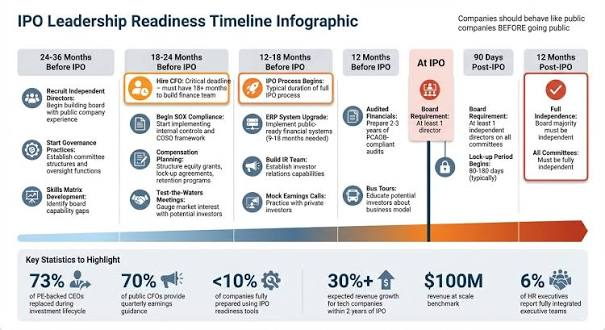
Going public is not a transaction that happens at the end of a process — it is the result of a process that takes shape long before any filing reaches the SEC. For most US companies, the distance between deciding to pursue an IPO and being genuinely prepared for one is measured in months of structural work, not weeks of documentation. Companies that misread this timeline tend to arrive at the public markets underprepared, which creates real risk not only for the offering itself but for their long-term credibility with institutional investors.
The challenge is not just compliance. It is organizational. A company transitioning from private to public ownership must rebuild internal systems, reporting structures, governance frameworks, and financial controls from the ground up — while continuing to run the business. The 12-month window before a planned IPO is not a buffer. It is the minimum viable preparation period for a company that takes the process seriously.
Why the 12-Month Window Defines IPO Outcomes
Most companies underestimate what ipo readiness actually requires until they are deep inside the process. It is not primarily about having clean financials, though that matters. It is about having the internal infrastructure to sustain public company standards over time. For teams that have operated with private company flexibility — informal decision-making, lean financial reporting, limited board oversight — the structural shift can be significant. A detailed Ipo Readiness guide can help leadership teams understand the full scope of what is expected before the process begins, rather than discovering gaps once advisors are already engaged.
The 12-month timeline also serves a practical purpose for external stakeholders. Underwriters, legal counsel, and auditors require lead time to conduct due diligence, identify weaknesses, and allow the company time to address them before the S-1 registration statement is filed. Rushing this window increases the likelihood of material deficiencies surfacing during the review process, which can delay the offering or create disclosure obligations that complicate the narrative presented to investors.
The Cost of Compressing the Timeline
When companies attempt to accelerate IPO preparation beyond what the process reasonably allows, specific types of problems become more likely. Financial restatements are among the most damaging, as they signal to investors that internal controls were insufficient during the period leading up to the offering. Governance gaps — including incomplete audit committee formation, unclear board independence standards, or undocumented executive compensation frameworks — can surface during SEC review and require amendments that push back the offering date.
There is also an operational cost to compressed preparation. The teams responsible for finance, legal, and HR are simultaneously managing daily business operations and an IPO workload that would challenge a fully staffed public company. Without adequate time built into the schedule, errors accumulate, key hires are deferred, and critical decisions are made reactively rather than strategically. The 12-month window is not conservative — it is realistic.
Months One Through Three: Structural Assessment and Gap Analysis
The first quarter of IPO preparation is diagnostic in nature. Before any external advisors are formally engaged, the company needs an honest internal assessment of where it stands against public company requirements. This includes a review of financial reporting quality, the maturity of internal controls, the completeness of board composition, and the state of corporate governance documentation.
This phase is also when the company selects its core advisory team — lead underwriters, securities counsel, and the audit firm that will provide the PCAOB-compliant financial audits required for SEC registration. The SEC’s guidance for companies going public outlines the registration requirements that inform which areas need immediate attention during this early phase.
Building the Right Internal Team Before the Process Accelerates
Many growth-stage companies lack the internal finance and legal infrastructure that public company operations require. The CFO role, in particular, often needs to be upgraded or supplemented during this phase. A CFO who has succeeded in a high-growth private environment may not have experience managing SEC reporting cycles, investor relations, or the quarterly close processes that public companies are held to. Identifying this gap in the first quarter allows enough time to hire, promote, or engage interim leadership before the process reaches a stage where their involvement is critical.
The same applies to the audit committee. Public companies are required to have an audit committee composed of independent directors with financial expertise. If the board does not currently meet these requirements, the first quarter is when recruitment should begin — not month nine.
Months Four Through Six: Financial Reporting and Controls Development
The middle of the 12-month process is where financial infrastructure becomes the primary focus. Companies are expected to present two to three years of audited financial statements in their S-1, depending on their classification under the JOBS Act. If the company’s historical financial records are not audit-ready — meaning they were prepared under less rigorous standards than GAAP or contain inconsistencies in revenue recognition, expense classification, or capitalization policy — this phase is the window to address it.
Internal controls over financial reporting, commonly referenced as ICFR, represent another major workstream during this period. While newly public companies under certain classifications have a limited period before full Sarbanes-Oxley compliance is required, the underlying control framework should be designed and in place before the IPO. Investors and underwriters will expect evidence that the company can produce accurate and reliable financial data on a repeatable basis.
Revenue Recognition and the Risk of Restatement
Revenue recognition is one of the most common sources of material weakness identified in pre-IPO audits. For companies in software, services, or multi-element contract arrangements, the transition to ASC 606 standards — or the correct application of standards already in effect — can require retrospective adjustments to prior period financial statements. Discovering this in month ten of a 12-month preparation window is a significant problem. Discovering it in month five allows time for restatement, re-audit, and disclosure planning before the S-1 is drafted.
This phase should also include the design of the close calendar, the internal reporting cadence, and the systems infrastructure needed to support quarterly earnings reporting after the company goes public. Investor expectations around reporting discipline begin at the IPO, and companies that cannot close their books within a reasonable period will face criticism from analysts and institutional investors from the beginning.
Months Seven Through Nine: Governance, Legal, and Organizational Readiness
By the third quarter of preparation, the focus shifts toward formal governance structures and the legal documentation that underlies them. This includes the finalization of board committee charters, insider trading policies, whistleblower procedures, and disclosure controls policies. These are not administrative formalities — they are the framework through which a public company manages its obligations to shareholders and regulators on an ongoing basis.
Equity compensation plans, employee agreements, and related-party transaction records should all be reviewed and documented during this phase. The S-1 will require disclosure of material related-party transactions, and incomplete records create both legal and reputational exposure. The legal team should also be completing entity-level cleanup work — consolidating subsidiaries, resolving outstanding litigation, and clearing any encumbrances on material assets.
Preparing the Organization for a New Operating Standard
Public company life changes the internal operating rhythm of an organization in ways that are not always visible until they arrive. Quarterly earnings cycles, investor relations communications, and the heightened scrutiny that comes with public ownership all require a workforce that understands its responsibilities differently than before. ipo readiness, at this stage, is not just a finance and legal problem — it is a management and culture problem.
Leadership teams benefit from conducting internal training sessions on material non-public information policies, blackout periods, and the behavioral expectations that come with public company status. Employees who interact with external parties — sales, partnerships, investor-facing communications — need to understand what has changed and why it matters.
Months Ten Through Twelve: The Registration Process and Final Preparation
The final quarter is when the company moves from preparation into execution. The S-1 registration statement is drafted, reviewed, and filed with the SEC. This document is both a legal disclosure and a narrative document — it must accurately present the business, its risks, its financials, and its growth trajectory to a sophisticated investor audience. The drafting process typically involves multiple rounds of revision across the company’s legal, finance, and executive teams.
The SEC review process itself introduces additional variables. Comments from SEC staff must be addressed in writing, and additional rounds of review are common. Companies that have done the preparation work in the prior nine months are far better positioned to respond quickly and accurately to SEC comments than those who have deferred structural work to the final quarter.
The roadshow — the period during which management presents to institutional investors ahead of pricing — typically occurs in the weeks immediately before the offering. By this point, every major preparation task should be complete. The roadshow is not the time to be resolving audit findings or drafting governance policies. It is the time to tell the company’s story with confidence and consistency.
Conclusion
A 12-month IPO preparation timeline is not designed to be comfortable — it is designed to be sufficient. Companies that work through the process in a disciplined, sequenced way arrive at the public markets with stronger governance, cleaner financials, and a more credible internal infrastructure. Those that treat preparation as a back-end exercise tend to face the consequences in the form of SEC comments, delayed filings, and investor skepticism that is difficult to reverse.
The decision to go public is ultimately a decision to operate at a higher standard across every dimension of the business. IPO readiness is the process of building that standard before it is formally required. For companies serious about a successful offering, the work begins now — not in the final stretch.
