
Hands are worth looking after because of everything they make possible, and most people who notice joint discomfort in a hand want the same thing: to keep doing what they were doing. That goal is realistic for a great many people, and it starts with knowing which joints are actually involved.
Arthritis is a broad word covering conditions that behave differently, appear in different joints, and are approached in different ways. A person told they have arthritis in their hand has been given a category rather than an answer, and the useful detail sits underneath it.
The Two Patterns Most Often Discussed
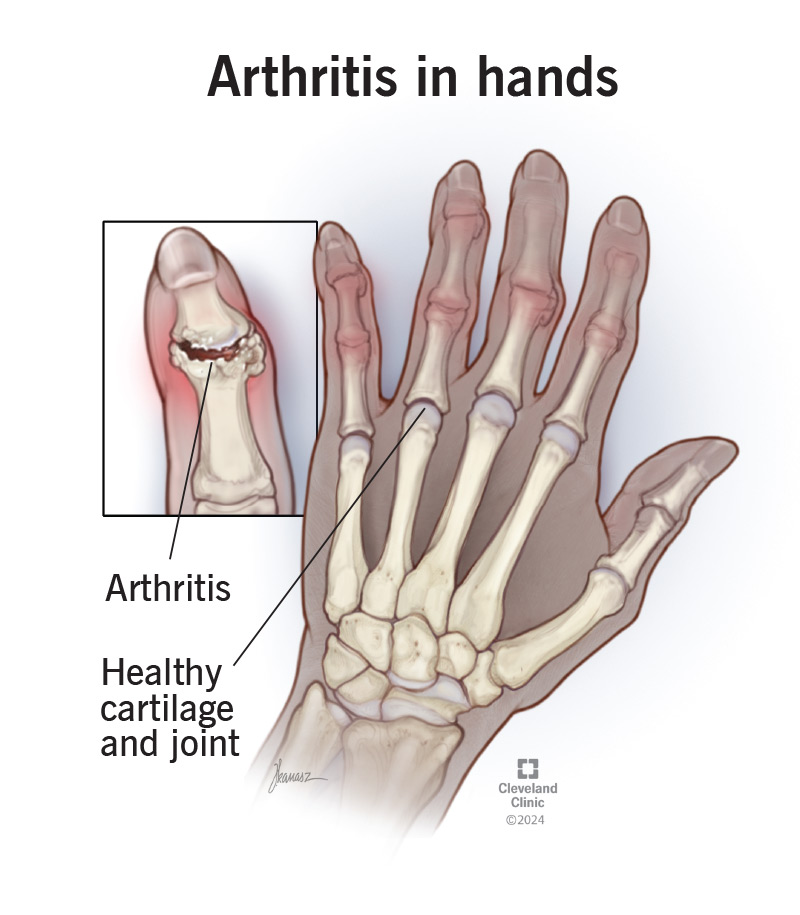
Osteoarthritis relates to changes in the joint surfaces over time. In the hand it tends to appear in particular locations: the base of the thumb, the joints nearest the fingertips, and the middle finger joints. It commonly affects some joints while leaving others unaffected, and it does not necessarily appear symmetrically.
Inflammatory arthritis, of which rheumatoid arthritis is the most familiar example, works differently. It involves the immune system acting on the joint lining, frequently affects joints on both hands in a symmetrical pattern, often involves the knuckles and the middle finger joints while sparing the joints nearest the fingertips, and can be accompanied by prolonged morning stiffness and effects beyond the joints themselves.
This distinction matters a great deal, because inflammatory arthritis is managed medically by specialists and early identification is important. Anyone with joint swelling in both hands, prolonged morning stiffness, or symptoms accompanied by fatigue or feeling generally unwell should see a physician rather than working through self-help options.
Where Hand Osteoarthritis Tends to Appear
Knowing the common locations makes symptoms easier to describe and easier to discuss.
- The base of the thumb. Among the most common sites in the hand. Discomfort typically appears during pinching and twisting tasks rather than at rest.
- The joints nearest the fingertips. These can develop bony enlargements over time, which are frequently more noticeable visually than they are troublesome functionally.
- The middle finger joints. Less commonly affected than the fingertip joints in osteoarthritis, and more disruptive to grip when they are, because these joints do a great deal of work in closing the hand.
- The wrist. Often related to previous injury rather than appearing on its own, and it affects a wide range of tasks because so much hand function depends on wrist position.
Because the pattern of involvement differs between people, two individuals with the same diagnosis can have quite different practical experiences and quite different priorities.
What Support Looks Like in Different Places
Support options follow the anatomy, and what is available varies considerably by joint.
At the base of the thumb, support that stabilises the joint while leaving the wrist and fingers free is a well-established approach, because the functional demand is stability during pinch rather than rest.
At the wrist, options range from supports that restrict motion substantially to those providing more targeted stability while retaining useful movement. Which is appropriate depends on whether the aim is rest or support during activity, and on what a clinician has advised.
At the finger joints, options are more limited and often smaller in scale, and hand therapists frequently place more emphasis on how tasks are performed and on adaptive equipment than on external support.
Across all of them, the same principle applies: a support that prevents someone from doing what they wanted to do will not be worn, so what a person can accomplish while wearing it is a legitimate part of the assessment rather than an afterthought.
The Approaches That Sit Alongside Support
External support is one element of a broader picture that hand therapists typically work through.
Adapting how tasks are performed is usually the largest contributor and costs nothing. Using larger joints instead of smaller ones, spreading load across the whole hand rather than pinching, and avoiding sustained grip all reduce demand on sensitive joints.
Adaptive equipment removes demand entirely in specific tasks: wider handles, jar openers, key turners, lever taps, and lighter tools each eliminate a load rather than reducing it.
Exercise programmes appropriate to the individual and the joints involved are commonly part of hand therapy, and they are worth doing under guidance rather than from a general video, since what suits one pattern of involvement may not suit another.
Medical options including medication and injections are discussed by physicians where relevant, and surgical options exist for some situations. Those conversations belong with clinicians who know the individual case.
Where support forms part of the plan, an arthritis brace is one of several categories BraceLab carries, alongside wrist, elbow, knee and other supports and a library of clinical education material. BraceLab is the exclusive U.S. distributor of Push and Push Sports braces and was founded by Judy C. Colditz, OT/L, CHT, FAOTA, a hand therapist who has led both national and international hand therapy societies. Which support suits which joint is a question best answered after an examination rather than from a product description.
Getting an Actual Answer
A useful clinical conversation is easier if you arrive prepared. Worth noting beforehand: which joints are involved, whether both hands are affected, whether stiffness occurs in the morning and how long it lasts, which specific tasks are difficult, whether there is swelling, and whether anything else has changed in your general health.
That set of observations helps a clinician considerably, because the pattern often points toward the answer before any imaging is arranged.
Key Takeaways
- Arthritis is a category rather than a diagnosis, and the detail underneath it determines what helps.
- Osteoarthritis in the hand favours particular joints and is often asymmetrical.
- Inflammatory arthritis frequently affects both hands symmetrically, involves prolonged morning stiffness, and needs medical assessment promptly.
- The base of the thumb and the joints nearest the fingertips are among the most commonly involved sites in hand osteoarthritis.
- Support options follow the anatomy and differ substantially between the thumb, wrist, and finger joints.
- Adapting tasks and using adaptive equipment often contribute more than any product does.
- Noting the pattern of symptoms before a clinical visit makes the appointment considerably more productive.
Frequently Asked Questions
How do I know which type of arthritis I have?
Through clinical assessment, which may include examination, blood tests, and imaging depending on what the pattern suggests. The distinction matters because inflammatory arthritis is managed medically and benefits from early identification, so this is a question for a physician rather than for a self-assessment.
Are the bumps near my fingertips a problem?
Bony enlargements at the joints nearest the fingertips are a recognised feature of hand osteoarthritis. Many people find them more noticeable in appearance than in function. Any new or changing lump in the hand is nonetheless worth having assessed rather than assumed, since several things can produce swelling in that area.
Does hand arthritis mean I should stop using my hands?
Rarely. Hand therapists generally focus on modifying how tasks are performed rather than eliminating activity, since disuse brings problems of its own. What that looks like for a specific person depends on which joints are involved, which is why individual guidance is more useful than general advice.
Can support be used on more than one joint?
It can, and some people use different supports for different situations. What works together without one interfering with another is worth discussing with a hand therapist, who can look at the whole hand rather than each joint separately.
Will exercises make it worse?
Appropriate exercise is commonly part of hand therapy, and inappropriate exercise can provoke symptoms. Since what is appropriate depends on which joints are involved and on the individual, this is worth doing under guidance rather than from a general programme found online.
When should I see a specialist?
Reasonable prompts include symptoms in both hands, prolonged morning stiffness, visible swelling, symptoms accompanied by fatigue or feeling unwell, discomfort that is worsening, or difficulty with activities that matter to you. Earlier assessment generally provides more options.
Conclusion
Hand arthritis covers a range of conditions in a range of locations, and the practical route forward begins with knowing which joints are involved and which pattern is present. Once that is clear, the options become specific rather than general: support where support helps, adapted technique where technique matters, equipment where equipment removes a load, and medical care where it is needed. Most people find there is considerably more available to them than the single broad word suggests.
