
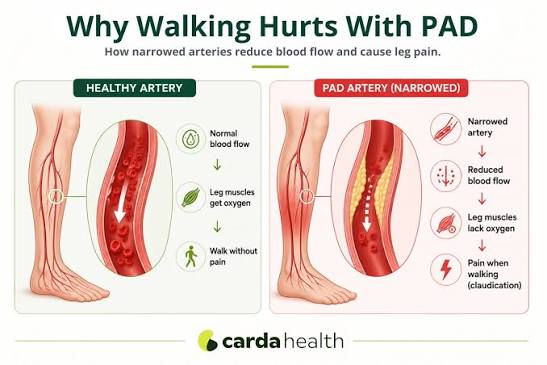
Many people in their 50s, 60s and 70s accept leg pain as part of getting older. They slow down on walks, stop to let the cramp pass, and keep going. But pain that shows up when you walk and eases when you rest has a name, claudication, and it is often the first sign of peripheral artery disease (PAD).
What PAD is
PAD happens when plaque narrows the arteries that carry blood to the legs. Working muscles need more oxygen. When narrowed arteries cannot deliver it, the calves, thighs or hips ache, cramp or feel heavy. Rest lowers the demand, so the pain fades within a few minutes. The same plaque process drives heart attacks and strokes, which is why PAD is treated as a warning about the whole circulation, not only the legs.
Signs worth paying attention to
- Cramping, aching or tiredness in the calves, thighs or buttocks when walking or climbing stairs that eases with rest
- One foot or leg that feels colder than the other
- Sores on the toes, feet or legs that heal slowly or not at all
- Shiny skin, hair loss on the legs, or toenails that grow slowly
- A weak or missing pulse in the feet
- Leg or foot pain at rest, especially at night, that improves when the leg hangs over the side of the bed
Some people with PAD have no symptoms at all, so risk factors matter as much as symptoms.
Who is at higher risk
Smoking is one of the strongest risk factors. Diabetes, high blood pressure, high cholesterol, kidney disease, a history of heart disease or stroke, and age over 65 all raise risk. Adults over 50 with diabetes or a smoking history are good candidates for a conversation about screening.
How it is checked
The first test is usually simple. An ankle-brachial index (ABI) compares blood pressure at the ankle with blood pressure in the arm using regular cuffs and a small ultrasound probe. It takes minutes and involves no needles. If the numbers suggest a blockage, an arterial ultrasound can show where blood flow is reduced and how severe the narrowing is.
Treatment often starts without surgery
Most people begin with steps that protect both the legs and the heart: stopping smoking, a structured walking program, and medicines to manage cholesterol, blood pressure, blood sugar and clotting risk. Supervised walking programs can meaningfully increase how far people walk before pain starts. When symptoms limit daily life or blood flow is severely reduced, minimally invasive procedures such as angioplasty and stenting can reopen narrowed arteries. The right plan depends on the test results and the person’s overall health.
Questions to bring to your visit
- Is my leg pain coming from my arteries, my veins, my back or my joints?
- What did my ABI show, and do I need an ultrasound?
- How far should I walk each day, and how should I build up?
- Which of my medicines protect my circulation?
- Which signs mean I should call right away?
When to get checked
Book a visit if walking brings on leg pain that fades with rest, if a foot sore is slow to heal, or if you have diabetes or a smoking history and have never had your leg circulation checked. Seek emergency care for a leg that suddenly becomes cold, pale, numb or very painful, which can signal a blocked artery.
For people in The Woodlands, Shenandoah, Spring and Conroe, the PAD and vein specialists in The Woodlands at Healthy Living Heart and Vein evaluate leg pain with ABI and ultrasound and build treatment plans around the results. The office is at 18488 I-45, Suite 200, Shenandoah, TX 77384, and can be reached at (936) 978-0466.
Leg pain that stops you mid-walk is worth a closer look. Catching PAD early protects your legs and gives you a head start on protecting your heart. Learn more about the condition from the National Heart, Lung, and Blood Institute.
