
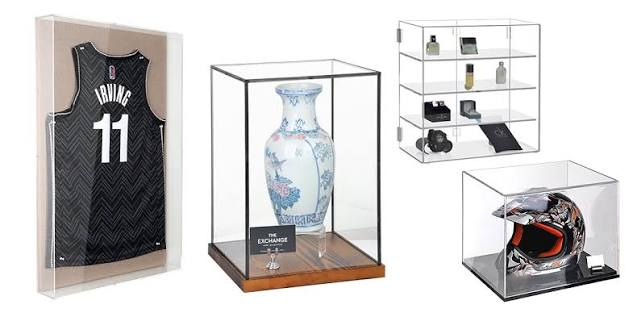
Choosing a display case sounds straightforward until you’re standing in front of a wall with product in hand and no clear sense of what will actually hold up over time. For retailers managing floor space, collectors protecting valuable items, or institutions presenting objects to the public, the wrong choice creates real problems — scratched surfaces, failed mounts, distorted visibility, and displays that age poorly under ordinary lighting conditions. These are not abstract concerns. They come up regularly, and they come up because most buyers approach the purchase without a working understanding of what acrylic display cases actually involve at the structural and operational level.
This guide addresses that gap. It covers what matters before purchase, what questions to ask, and what to expect from wall mounted acrylic display cases across different use environments in the US market.
Understanding What Wall Mounted Acrylic Display Cases Actually Are
Wall mounted acrylic display cases are enclosed or semi-enclosed transparent containers fixed directly to a wall surface, designed to present objects while protecting them from dust, handling, and environmental exposure. Unlike freestanding cases or countertop units, they occupy vertical space rather than floor or surface area, which makes them practical in environments where space is limited or where a clean, permanent installation is preferred. The wall mounting element is not cosmetic — it fundamentally changes how the case interacts with the wall structure, how weight is distributed, and what installation requirements apply.
Acrylic, as a material, is a synthetic polymer commonly used as a glass substitute in display applications. It is lighter than glass, less prone to shattering, and can be manufactured in various thicknesses and finishes. For anyone researching this category in depth, the Wall Mounted Acrylic Display Cases guide covers structural options and configurations that reflect current product availability in the US market and helps buyers match case specifications to actual display needs.
What makes acrylic specifically useful in display contexts is its optical clarity when properly manufactured. Lower-quality acrylic introduces visual distortion or yellowing, which affects how objects appear to viewers. This is a material quality issue, not a design issue, and it is worth understanding before comparing products at different price points.
The Relationship Between Material Grade and Long-Term Performance
Not all acrylic is manufactured to the same standard. Cast acrylic and extruded acrylic are the two primary production methods, and they produce material with different physical properties. Cast acrylic tends to offer better optical clarity, more consistent thickness, and greater resistance to surface crazing over time. Extruded acrylic is produced at higher volume and lower cost, which makes it common in budget-oriented products, but it is more susceptible to stress marks and surface scratching under regular use.
For permanent wall installations in retail or institutional settings, material grade has compounding effects over time. A case that looks acceptable at installation may show visible degradation within a year or two if the acrylic is low quality. This matters especially when the case houses collectibles, branded merchandise, or objects with significant value — either monetary or representational. Buyers who focus solely on initial price often underestimate the cost of replacing or refinishing cases prematurely.
Evaluating Mounting Systems Before Installation
The mounting system is the most technically consequential part of a wall mounted display case. It determines how the case attaches to the wall, how that attachment holds over time, and what wall types or construction materials the case is compatible with. Many product descriptions understate this. A case may be described as wall mountable without specifying whether it requires stud placement, masonry anchors, toggle bolts, or a dedicated bracket rail system.
In US construction, interior walls vary significantly — drywall over wood studs, drywall over metal studs, concrete masonry in commercial buildings, and tile or paneled surfaces in retail environments. Each wall type requires different anchor types and load calculations. A mounting system designed for wood studs will not perform reliably in a metal stud wall without modification. Installing a case without matching the anchor type to the wall construction is one of the more common causes of display failure, particularly as the weight of displayed objects increases over time.
Load Distribution and Structural Risk
Wall mounted display cases introduce a sustained, static load to the wall surface. Unlike a framed picture or shelf bracket where the load is distributed along a horizontal contact point, enclosed display cases often have a smaller, more concentrated contact area depending on their mounting design. This concentration increases stress at specific anchor points.
When cases hold heavy objects — ceramic pieces, sporting memorabilia, electronic devices, or dense collectibles — the load at each anchor point can exceed what the fastener alone is rated to hold if the installation was not planned for that weight. This is not a failure of the case itself, but a failure of installation planning. In retail environments, where displays may be reconfigured frequently, the same wall section may experience repeated fastener loads, which degrades the holding capacity of the wall material over time.
Buyers should request clear installation documentation that includes anchor type recommendations by wall construction category. Any reputable supplier should provide this, and the absence of it is a practical warning sign.
Optical Clarity and Viewing Conditions
Display cases exist to make objects visible. That statement is obvious, but the factors that determine actual visibility in a real environment are more involved than they appear. Acrylic clarity is affected not only by material grade, but by panel thickness, surface finish, and the angle of available light. In a retail setting with overhead fluorescent or LED lighting, thicker acrylic panels can produce internal reflections that interfere with the viewer’s sightline. In a room with large windows, ambient light can create glare across the front face of the case.
Anti-reflective coatings and UV-filtering acrylic formulations address some of these conditions, but they add cost and are not universally available across product lines. Buyers should consider their specific lighting environment before selecting a finish or panel type. A case that performs well in a showroom under controlled lighting may behave differently when installed in a high-ceiling retail floor with mixed lighting sources.
UV Protection and Object Preservation
Acrylic has variable UV transmission properties depending on how it was manufactured. Standard acrylic transmits a portion of ultraviolet light, which causes fading and material degradation in many types of displayed objects — fabrics, dyes, paper labels, photographs, and certain polymers. For objects with significant value or sensitivity to light, UV-filtering acrylic is the appropriate choice.
According to the Smithsonian Institution’s guidelines on preventive conservation, controlling light exposure — particularly UV radiation — is one of the primary factors in protecting objects from irreversible damage over time. UV-filtering acrylic addresses this at the case level without requiring additional window treatments or lighting restrictions in the surrounding environment. For collectors or institutions presenting sensitive materials, this is not a premium feature — it is a baseline requirement.
Common Use Environments and How They Shape Case Selection
Wall mounted acrylic display cases are used across a wide range of environments in the US, and the operating conditions of each environment place different demands on the product. Understanding this prevents buyers from applying residential logic to commercial installations or commercial-grade expectations to personal collector setups.
In retail settings, cases are subject to frequent handling by staff during restocking, exposure to varied ambient temperatures if near entrances, and ongoing contact with cleaning products. Cases used in retail need to be easy to open and close repeatedly, constructed with hinges or access mechanisms that hold up under regular use, and made from materials that clean well without surface damage from common retail-grade cleaning solutions.
In collector environments — private homes, hobby spaces, game rooms — the operational demands are lower in frequency but the aesthetic standards are often higher. Collectors tend to view their displays in detail and notice surface imperfections, edge quality, and mounting precision more acutely than a retail customer walking past a display. For these buyers, fit and finish matter as much as structural performance.
Institutional and Commercial Display Requirements
Museums, libraries, government offices, and corporate lobbies represent a distinct use category. These environments often require cases that meet specific accessibility or fire code compliance standards, particularly when installed in public-facing areas. The Americans with Disabilities Act provides guidance on protrusion limits for wall-mounted objects in accessible pathways, which affects how far a display case can extend from the wall surface in corridors or public circulation areas.
Institutional buyers often work with procurement standards that require documentation of materials, load ratings, and installation specifications. Cases purchased without this documentation can create problems during facility audits or inspections. This is worth raising with any supplier before a purchase decision is made in an institutional context.
Practical Considerations Before Placing an Order
Before ordering wall mounted acrylic display cases, buyers benefit from working through a short set of practical questions that resolve the most common sources of post-purchase problems. These are not checklist items in the marketing sense — they are real decisions that affect installation success and long-term satisfaction.
• What is the wall construction type at the intended installation location, and does the case’s mounting system include appropriate anchor hardware for that wall type?
• What is the combined weight of the objects being displayed, and does that weight fall within the case’s supported load range at the planned anchor configuration?
• What are the lighting conditions in the installation space, and is standard acrylic clarity sufficient, or does the environment require anti-reflective or UV-filtering panels?
• How frequently will the case need to be opened for access, and is the access mechanism designed for that level of use without loosening or wearing prematurely?
• Are there dimensional constraints — ceiling height, adjacent fixtures, door swing clearance — that limit the case’s depth or width options?
• Does the installation location have any code compliance requirements related to wall projections, fire egress, or material standards in commercial or public settings?
These questions are practical and answerable before purchase. Working through them systematically removes the variables that most often result in a poor installation outcome or a case that doesn’t perform as expected in actual use.
Closing Considerations
Wall mounted acrylic display cases represent a category where the purchasing decision benefits from more deliberation than most buyers initially apply to it. The combination of structural installation requirements, material quality variables, optical performance factors, and use-environment differences means that two cases at similar price points can deliver very different results depending on where and how they are installed.
For retailers, the stakes are primarily commercial — a poor display affects how product is perceived and how efficiently the space functions. For collectors, the stakes are personal and often preservation-related. For institutions, they are both regulatory and representational. In each case, the path to a reliable outcome is the same: understand the material, understand the mounting system, match the case to the actual environment, and ask direct questions of the supplier before committing.
The US market offers a wide range of options across this product category, and quality does vary meaningfully. Buyers who take the time to understand what they are purchasing, rather than defaulting to lowest cost or most visible brand, consistently get better results over the life of the installation.
