
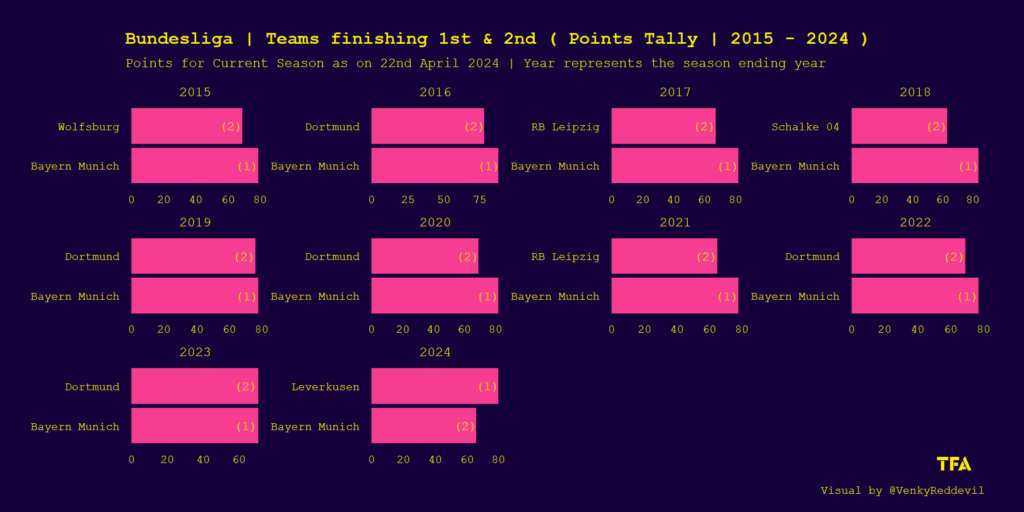
Talking about Bundesliga fixtures with “clear H2H stats” means looking for matchups where the historical record is decisively tilted—by result type, goals or both-teams-to-score—rather than roughly balanced over time. The key question is when those recurring head-to-head patterns add genuine information beyond current form and when they simply reflect outdated contexts.
What counts as a “clear” H2H pattern in practice?
A head-to-head record becomes meaningfully clear when one side consistently dominates results or when goal patterns (like over 2.5 or both teams scoring) repeat well above league norms across a sizeable sample. Tools covering derbies and rivalries show how some pairings, over 10+ recent meetings, lean strongly toward specific outcomes. For example, Bayern vs Dortmund (Der Klassiker) has long been tilted toward Bayern wins, with 55 league victories to Dortmund’s 26 and 30 draws in Bundesliga play alone.
Another form of clarity is stable goal environment: some fixtures are repeatedly high-scoring, while others trend toward low totals. Bundesliga goal-trend tables show clusters of matchups where over 2.5 or over 3.5 goals hit in a majority of recent meetings, making the H2H record informative for tempo and openness expectations rather than just for 1X2.
Examples of Bundesliga rivalries with strong H2H signals
Der Klassiker between Bayern Munich and Borussia Dortmund is the most famous case of a historically clear pattern. Official league summaries show Bayern leading the league head-to-head with 55 wins to Dortmund’s 26, and broader all-competition numbers point to 68 wins for Bayern versus 34 for Dortmund in 133 total meetings, with a particularly dominant stretch of 14 wins in the last 17 Klassikers since 2017. That trend reveals a long-run imbalance in how Dortmund cope with Bayern’s structure at the very top level.
The Revierderby between Dortmund and Schalke offers a different type of clarity: long-term balance but high volatility. The Bundesliga record stands at 37 wins for Dortmund, 32 for Schalke and 31 draws across 100 league meetings, showing that both sides have had extended spells of dominance. The clearest signal here is not a single dominant side but the consistent intensity and unpredictability: many derbies swing away from recent form and involve comebacks or late goals.
When H2H goal patterns are more informative than results alone
For many non-derby fixtures, the headline win–draw–loss split is fairly balanced, but goal patterns show clearer structure. Goal-trend stats indicate, for example, that some pairings featuring Bayern, Stuttgart or Hamburg have over 2.5 goals in 70–100% of recent games, while other recurring matchups involving Union Berlin or Mainz tend to sit below that line more often.
In these cases, the H2H record suggests that style interactions—pressing vs build-up, wide crossing vs compact blocks—tend to create either open or closed contests regardless of which side is in better short-term form. That makes H2H more useful for reading likely tempo, chance volume and both-teams-to-score probability than for predicting a single winner.
Comparing clear-win trends with clear-goal trends
Clear-win trends (like Bayern’s dominance over Dortmund in recent Klassikers) indicate that one club’s game model and resource edge has repeatedly translated into points across multiple cycles of players and coaches. Clear-goal trends (like consistently high-scoring or low-scoring pairings) instead highlight stable tactical interactions: even when results switch, match flow remains recognisable.
Both types of clarity can be meaningful, but they answer different questions. The first speaks to asymmetry in underlying strength; the second to the kind of game both teams tend to produce together.
How to read H2H information in applied evaluation with UFABET
From an educational, situation-based perspective, head-to-head records only become valuable once they are connected to present-day structure. During the decision-making process on ufabet168 เข้าสู่ระบบ through a football betting website or similar web-based service, a useful approach is to treat clear H2H patterns as a secondary filter: first assess current form, injuries and tactics; then check whether the historical record reinforces or contradicts those conclusions. H2H dominance—like Bayern’s long run of wins in Der Klassiker—carries more weight when the superior side remains strong in the current season; it matters far less if squad quality and styles have shifted dramatically. Likewise, longstanding high-goal H2H trends deserve more attention when both teams still play similarly open football; if one has recently shifted to a compact, low-risk model, blindly trusting old goal patterns can be misleading.
List: Structured steps for identifying “clear H2H” Bundesliga fixtures
Because almost every pairing has some history, a structured checklist helps separate genuinely informative H2H records from noise. The aim is to combine sample size, recency and tactical stability before calling any matchup “clear.”
- Check the basic head-to-head record over a meaningful window (for example, last 10–15 competitive meetings), noting win–draw–loss splits and goal difference between the sides.
- Look at H2H goal trends: frequency of over 2.5 or over 3.5 goals and both-teams-to-score hits compared with league averages, using trend tables and BTTS stats.
- Assess whether both teams still play in a similar style to previous seasons—for instance, whether an attacking side has remained proactive or shifted toward a more conservative approach.
- Consider rivalry and stakes: long-standing derbies (Klassiker, Revierderby, regional rivalries) tend to maintain characteristic intensity that can preserve certain H2H traits across multiple eras.
- Finally, compare H2H implications with current season data; if historical patterns align with current form, they may reinforce expectations; if they conflict, prioritise present structure over old numbers.
Using this sequence means that head-to-head stats are never the sole basis for conclusions. Instead, they act as a cross-check that either strengthens or weakens hypotheses built from contemporary performance.
Table: Types of “clear” H2H patterns seen in Bundesliga fixtures
Different fixtures exhibit clarity in different ways. The table below groups common H2H patterns and summarises how each should be interpreted.
| H2H pattern type | Example characteristics | Practical meaning |
| Long-term result dominance | One team with large win lead and strong recent run (e.g. Bayern over Dortmund in Klassikers: 14 wins in last 17) | Indicates structural gap that has persisted over eras |
| Balanced results, high volatility | Near-even W–D–L, many comebacks and swings (e.g. Dortmund–Schalke Revierderby) | Suggests derby chaos; less predictive for exact result |
| Stable high-goal environment | Majority of last meetings over 2.5 or 3.5 goals vs league norms | H2H more useful for reading tempo and openness |
| Stable low-goal environment | Repeated under 2.5 goals, low BTTS rates | Indicates stylistic clash that suppresses scoring |
| No clear pattern | Mixed results, mixed totals, frequent tactical change | H2H adds little; current-season data should dominate |
In this framework, Der Klassiker clearly fits the first row, while Revierderby sits nearer the second: its head-to-head record is rich but not straightforwardly predictive of a single outcome. Many non-derby fixtures sit in the third or fourth rows, where goal-and-BTTS trends tell more than raw W–D–L.
Where reliance on “clear” H2H can go wrong
Over-reliance on head-to-head records fails when it ignores how much teams evolve. New coaches, tactical overhauls and major squad turnover can dramatically change how a side behaves, making matches from even three or four seasons ago a poor guide. Treating those games as equally relevant can anchor expectations to outdated realities.
Small-sample distortions are another risk. A run of three or four unusually high-scoring or one-sided results can make an H2H column look “clear” when the broader context is more balanced. Without checking sample size and league-wide baselines, it is easy to see patterns where there is only variance. Tools that highlight only the last few meetings without deeper historical context can amplify this illusion.
Summary
Bundesliga fixtures with genuinely clear head-to-head stats fall into a few recognisable categories: long-term dominance (as in Bayern vs Dortmund), volatile but characteristic derbies (like Dortmund vs Schalke), and matchups where goal or BTTS patterns repeat well above league norms. When these patterns are aligned with current form, style and stakes, they can sharpen expectations about result probabilities and game texture.
Used carefully—always as a secondary lens after present-season analysis—head-to-head records become a way to test whether historical matchups tell a consistent story or simply reflect scattered episodes. That distinction is what turns H2H from trivia into a structured tool for understanding how recurring Bundesliga fixtures tend to behave over time.
