
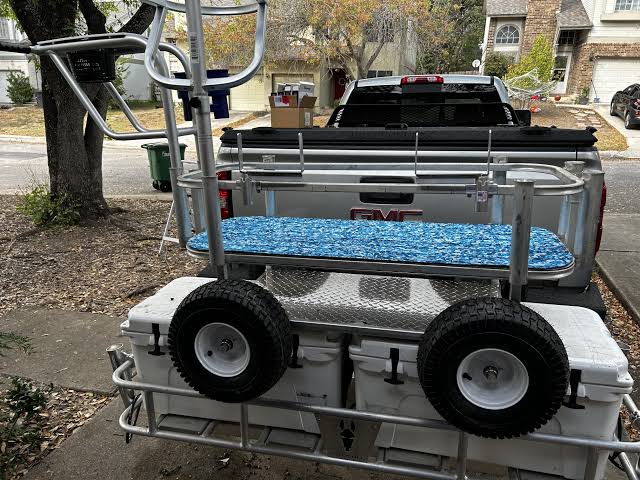
Capacity is the number on the box and the least useful one
Surf fishing along the American coast means carrying rods, coolers, and tackle across a few hundred yards of dry sand. A beach fishing cart rated at five hundred pounds will hold all of it easily, and holding it was never the difficult part.
The difficulty is moving a beach fishing cart across it. Sand offers no support until it has been compressed, so a wheel arriving on the surface begins to sink, and the force needed to keep going rises with every inch it settles.
A wheel in soft ground is always climbing out of a hole
Rolling resistance on a hard surface is small because the wheel is only overcoming friction. On sand the wheel deforms the ground beneath it and then has to climb the ridge it has just built, which is why pulling a loaded cart feels like going uphill on level ground.
The worst ground is rarely the widest stretch. Dry sand above the high tide line is loose and unpacked, and it is usually only the first thirty or forty yards, while the damp strip nearer the water is firm enough to roll on almost like pavement.
That climb is the whole problem. Every design feature of a beach fishing cart, from wheel size to tire pressure, exists to make the hole shallower rather than to make the cart stronger or hold more.
Diameter decides how steep the climb is
A large wheel on a beach fishing cart sinking to the same depth as a small one presents a much gentler slope to climb, in the same way that a long ramp is easier than a short one to the same height. Thirteen inches of diameter is doing that geometry rather than looking impressive.
Pressure matters more than width, and almost nobody adjusts it
A balloon tire spreads load by flattening its contact patch, and it can only flatten if the pressure inside is low. Run at the pressure that suits a paved path, the same tire stays round, carries all the weight on a small area, and digs in exactly like a hard wheel.
Dropping the pressure is free and transforms the cart. The contact area grows, the load per square inch falls, and the wheel rides nearer the surface, which is the single adjustment that turns a hard pull into a manageable one.
Four wheels and two wheels behave differently on sand
The four wheels of a beach fishing cart share the load and each one sinks less, but all four are cutting their own path and each contributes resistance. Two wheels sink further while making only two ruts, and on very soft dry sand that trade sometimes favors fewer wheels rather than more.
Pulling and pushing are not the same physics
Pulling a handle at an angle lifts slightly on the front of the cart, taking a little load off the leading wheels and letting them ride higher. Pushing drives them down instead, which is why the same cart moves more easily when towed than when shoved from behind.
Where the load sits changes the effort
Weight concentrated over the rear wheels of a beach fishing cart leaves the front pair lightly loaded and easier to float across the surface. Loading a cooler at the front does the opposite, and rearranging the same gear can make more difference than any amount of extra strength applied to the handle.
Salt water is patient with aluminum and merciless with steel
An aluminum frame forms its own oxide layer and stops there, which is why marine equipment is built from it. The fasteners, bearings, and hardware are the parts that fail, and stainless is worth insisting on wherever two components meet.
Rinsing is the maintenance that matters. Salt left in a bearing works away through the season regardless of what the frame is made of, and a few minutes with a hose at the end of a trip is the difference between wheels that still turn next season and wheels that have to be replaced.
Sand is an abrasive as much as salt is a corrosive. Sealed bearings keep both out, while plain bushings running on a bare axle grind themselves oval over a season, which is why the wheel hardware is worth looking at before anything else on a cart.
Rod holders decide how the cart is loaded and unloaded
Rods carried upright in tubes stay clear of the sand and out of the way of the load, and six of them means the whole party travels in a single trip rather than two. Angling them backward keeps the tips clear of dune vegetation and of anyone walking beside the cart.
Where it gets parked is a tide question
The wet sand near the water is far easier to roll on, which is exactly why people leave a cart there. Reading the tide line before setting up avoids the alternative, which is returning to find the wheels standing in water and the tackle already floating.
A cart parked on a slope also needs thinking about. Loaded weight on large wheels rolls away readily, and a cart left facing downhill toward the water has a habit of following the gradient while nobody is holding the handle, which is what the parking brake or a simple chock is for.
Carts divide by the ground they were shaped for
•Hard wheels: pavement, piers, and boat ramps
•Balloon tires: dry sand, run at low pressure
•Two wheel barrow style: soft sand, needs balance
Where a large wheeled cart pays and where it does not
•Strength: one trip instead of three across sand
•Strength: rods, cooler, and tackle carried upright
•Limit: bulky to transport and to store
•Limit: useless if the tires are left hard
Weighed against carrying gear by hand, a beach fishing cart costs space in the vehicle and returns the energy that would otherwise be spent before the first cast. An angler on the Outer Banks keeps a tire pressure gauge in his tackle box alongside the terminal tackle, which is not a common habit and probably should be.
Outdoor gear is increasingly judged on the walk in
Anglers and campers now weigh how equipment gets from a parking area to where it will be used, having found that the effort of arriving often decides whether a trip happens at all rather than how good it is once underway.
That focus on getting there is why the outdoor equipment TMG Industrial supplies is specified around wheels, frames, and how a load is carried rather than by capacity alone.
