
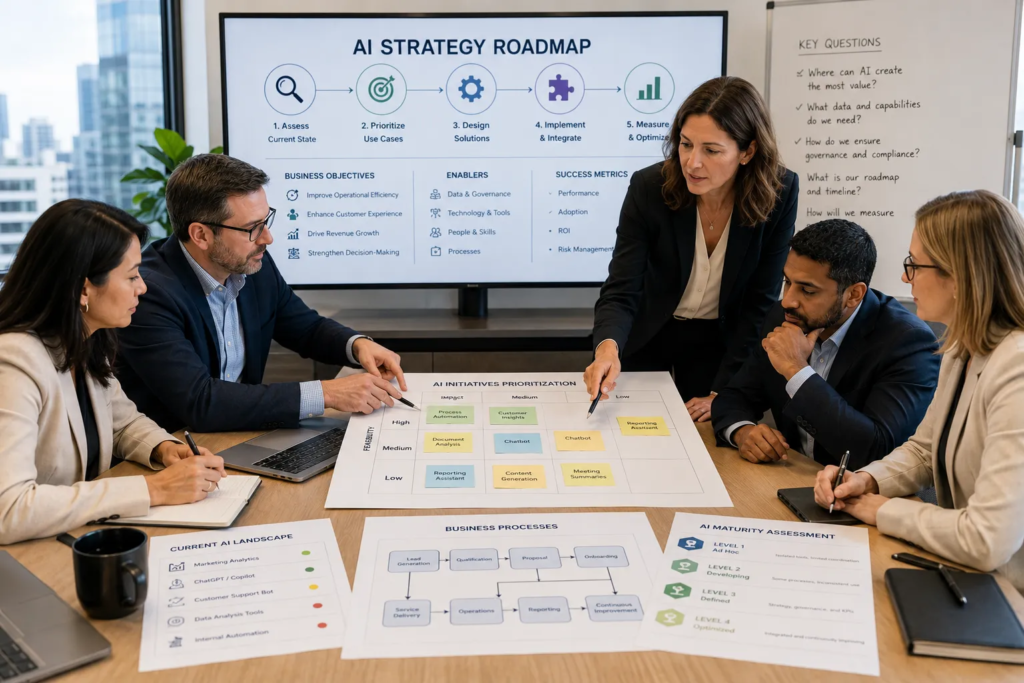
Artificial intelligence is becoming part of everyday business operations, from automating repetitive tasks to supporting customer service and improving decision-making. For many small and medium-sized businesses, AI adoption begins with a handful of standalone tools introduced by individual teams.
While this approach can produce quick wins, it often becomes difficult to manage as usage expands across the organization. Different departments may adopt separate platforms, duplicate capabilities, or develop inconsistent processes. Before investing in additional AI solutions, business leaders should determine whether they need a broader strategy to guide future adoption.
Here are five signs your organization may be ready for a more structured approach.
1. Different Teams Are Using AI Without Coordination
One of the earliest signs of growing AI maturity is when multiple departments begin using AI independently. Marketing may rely on one platform, operations another, and customer service yet another, each with different workflows and objectives.
Although these initiatives may deliver value individually, they can create unnecessary complexity when there is no shared direction. Teams may duplicate efforts, purchase overlapping software, or establish conflicting processes.
An organization-wide AI business strategy helps leaders evaluate existing initiatives, identify common goals, and determine where standardization can improve efficiency.
2. AI Projects Are Not Clearly Connected to Business Goals
Successful AI initiatives solve business problems rather than simply introducing new technology.
If new AI tools are being adopted because they are popular or promise automation, it may be time to reassess priorities. Every AI investment should support measurable business outcomes, whether improving customer experience, increasing operational efficiency, reducing administrative workload, or strengthening decision-making.
Without clearly defined objectives, organizations often struggle to evaluate return on investment or determine which projects deserve additional resources.
A strategic planning process keeps technology decisions aligned with long-term business priorities instead of short-term experimentation.
3. Employees Are Following Different Processes
As AI usage expands, inconsistent practices become more noticeable.
Some employees may use AI to draft reports, while others avoid it altogether. One department may have review procedures before AI-generated content is used, while another has no formal guidelines. Over time, these inconsistencies can affect quality, compliance, and operational efficiency.
Developing an operational AI strategy allows organizations to establish consistent expectations around governance, approval processes, data usage, and employee responsibilities.
Standardized processes also make it easier to train staff, monitor results, and expand AI adoption with greater confidence.
4. Technology Decisions Are Outpacing Planning
Many businesses discover new AI tools faster than they can evaluate them. With new platforms entering the market regularly, it is tempting to adopt additional software whenever a promising feature appears.
However, purchasing more technology does not automatically create better business outcomes.
Before expanding AI investments, organizations should develop an AI implementation planning process that identifies business priorities, evaluates existing systems, considers integration requirements, and establishes an implementation roadmap.
This approach helps leaders determine which opportunities deserve investment and which technologies may add unnecessary complexity.
5. You Are Planning to Scale AI Across the Business
Introducing AI into a single department differs significantly from expanding it across an organization.
As adoption grows, leadership must consider governance, security, change management, employee training, and long-term operational alignment. Without a coordinated strategy, scaling AI often leads to fragmented systems and inconsistent decision-making.
Many organizations reach this stage after several successful pilot projects. Rather than continuing to add tools independently, they benefit from evaluating how AI supports broader business transformation.
This is often the point where organizations seek external expertise. Firms such as Convex AI Systems offer AI strategy consulting to help businesses assess existing AI initiatives, establish implementation priorities, and develop strategic roadmaps before expanding into additional platforms or automation projects.
Building an AI Roadmap Before Adding More Technology
Every business reaches AI maturity at a different pace. Some organizations may only need a few focused automation tools, while others are preparing for enterprise-wide transformation.
The common factor among successful implementations is thoughtful planning. A well-defined AI roadmap provides direction for technology investments, establishes governance, aligns initiatives with business objectives, and creates a framework for measuring long-term success.
Rather than asking which AI tool to purchase next, business leaders should first ask whether their organization has the strategy needed to support sustainable growth. By putting planning before technology, businesses can reduce implementation risk, improve operational alignment, and ensure future AI investments contribute meaningful value across the organization.
